


If you enjoyed PART ONE of my series on outdoor learning activities, you’ve come to the right place for more!
Most of these activities are broad enough to appeal to many age groups, and can be done with multiple ages. If you’d like to learn more about how to get all your kids of various ages learning about the same thing at the same time, be sure to check out our newest ebook on how to use Unit Studies in your homeschool. Many of the following outdoor learning activities are great jumping off points for a unit study!
In addition, I’ve included a list of many academic subjects that correspond with each activity. So if you’re specifically looking for something to do outside to help with your poetry curriculum, for example, just search for poetry and it will come right up!
Without further ado, here are ten MORE favorite outdoor learning activities!
You can read the first ten educational outdoor activities on this post.
Activity #1: Catch (and release)


This one is sure to please the creepy-crawly lover in your life. Simply head for the great outdoors with some kind of bug or amphibian catcher and let your kids run wild! So-called “bug bungalows” are great because they also come with grabbing tools and magnifying glasses, but any container with air holes will do.
Your hunt can be used as a precursor to a unit on insects, arachnids, or amphibians (“where do different creatures live?”). However, it can also be capstone project where they show what they know about habitats and critters.
And though it’s not technically an academic subject, this activity is also a great segway into a conversation about empathy. Asking “How would you feel about being kept in a cage?” can help kids practice perspective-taking and be more willing to release their tiny prisoners.
Corresponding academic subjects:
- Math (counting the numbers of insects, number of legs, etc)
- Biology
Activity #2: Construct a bridge
For this activity, you can either source all your materials from the natural world around you, or bring stuff from the house outside. Either way, the goal for your child is to create a bridge and then test its soundness with a weight.
If your kids are especially into this activity, why not try a few variations? Switch up the kinds of materials they can use in construction (bark, sticks, twine, glue, leaves, vines, etc). Alternatively, you can make this easier or harder based on how much weight you try and get it to hold (large rocks vs a bag of leaves vs their little sibling, etc). Finally, you could try asking them to model their bridges on certain shapes like triangles or other famous bridges like the Golden Gate Bridge.
Corresponding academic subjects:
- Engineering
- Math
- Social studies/Geography (if talking about other famous bridges)
Activity #3- Create a ‘special place’

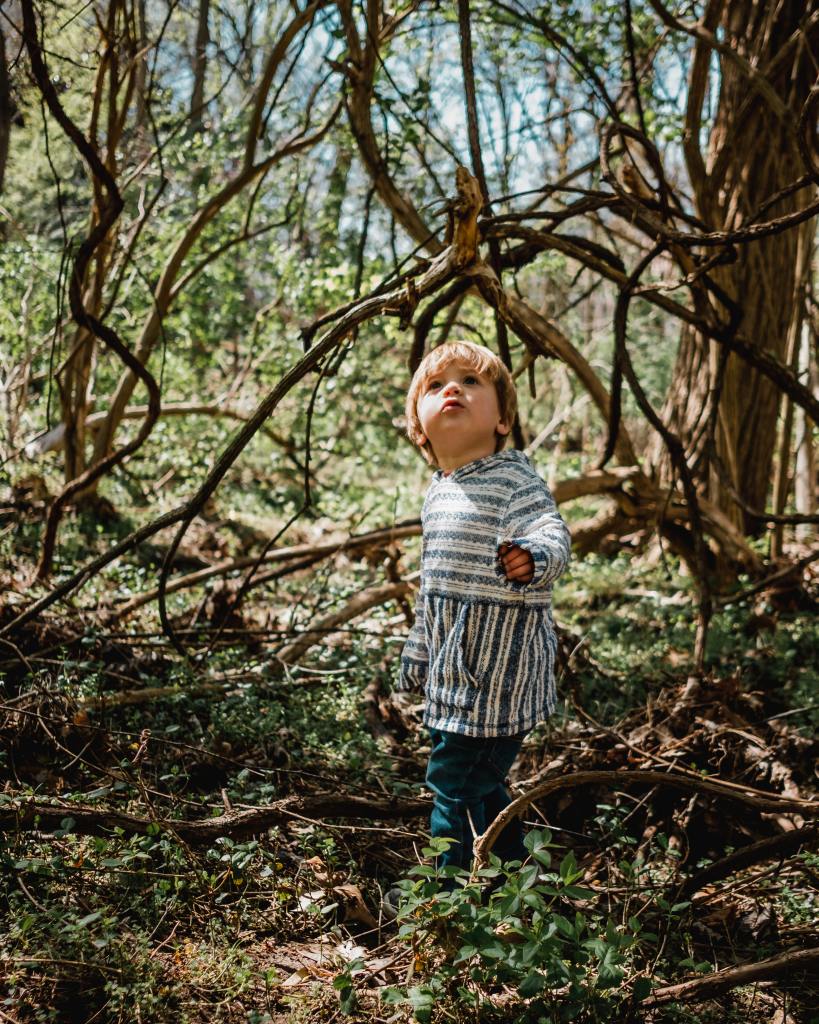
These are sometimes called “sit spots” in forest school literature. Regardless of what you call these outdoor learning activities though, the concept is the same. Your child will pick a little natural area for their own and regularly visit, writing notes & doodling each time about what they sense, notice, and feel there. You can also have them collect artifacts like leaves and flowers that they press into their nature journals. (I find paper with space for art/collections and lines for note-taking work best for younger writers. You can bind them up into a notebook ahead of time or send them out with single sheets on clipboards and bind them into a special book later!)
If you’re having multiple children create a special place at the same time, have all them spread out. Ideally, they’ll be at least three big paces away from each other or much more if you have the space to).
If you’re in a space that will remain undisturbed (personal property, rural land, unused portions of local parks), they can do more ‘construction’ on their space. Have them collect materials and make it comfortable (leaves, pine needles, a smooth rock, or an overturned log all make great seats). Create a roof, if desired.
Keep going back to that same spot regularly for many weeks, months, or even a full year. Have the children write about what the space looks, feels, smells, sounds like (leave out tasting!) every time they go. At the end, have them compare the changes.
In addition to academic benefits, this activity is great for stretching kids’ ability to sit quietly without much/any external stimulation. It also frequently increases a child’s imagination, since they’re sitting (sometimes bored!) for stretches of time.
Corresponding academic subjects:
- Art (drawing)
- Writing
- Science
Activity #4: Make flower crowns
There are two main ways to create a flower crown. One is to learn how to knot and/or weave different flowers and stems together. The other is to take strips of construction paper and tape or glue flowers onto one side before wrapping it around your child’s head. The best way is whichever is easiest!
While this could be a fun, stand-alone art project, you also can incorporate more elements.
- Have your child make different crowns; each crown can only use flowers with the same number of petals on it (or only odd/even numbers of petals).
- If using the paper and glue method, ask your child to use the flowers to spell out his/her name, or another vocabulary word.
- Very small children could make monochromatic crowns of single-color flowers (great for sorting skills!)
Corresponding academic subjects:
- Literacy
- Math (Counting)
- Art
Outdoor Learning Activities #s 5, 6, & 7- Create a weather station
I’ll admit, this activity might start as an indoor project. However, it has the potential to get you outside for a few minutes a day, every day, for as long as you’d like!
There are a number of different elements you could add to a weather station, depending on your children’s ages and their level of understanding. Broadly speaking though, there are easy ways to gauge temperature, wind (both speed and direction), and rainfall amounts for an average, homemade weather station.
Start by picking a good location where there’s no danger of wind toppling your instruments over or overhead cover to interfere with readings
- Put an outdoor thermometer out. You could also use two and compare the difference in temperature between sunny and shady locations
- Measure wind. Depending on your child’s age, you could simply make a flag and determine whether it is or isn’t windy. You could also make a weathervane and chart the wind’s direction day-to-day. Finally, you could go all in and create a wind turbine using dixie cups and straws and talk about differences in speed.
- You can create a rain gauge with a 2 litre bottle by cutting off the top third and inverting it into the bottle. Mark the bottle in regular intervals (centimeters work great). Then, empty it and measure its contents at the same time everyday. (If you don’t want to make your own, this rain gauge is an excellent, affordable substitute.)
Corresponding academic subjects
- Math (data collection, graphing, measuring, and possibly statistics)
- Writing (keeping a weather journal)
- Meteorology
Outdoor Learning Activities #8, 9 & 10: Fun with food


- Plant a garden! Don’t worry if you’re short on space, though. You can just as easily do this activity by planting seeds in a pot that sits on your porch or windowsill. You can try different seeds, different soils, different locations, and even different amounts of watering to make this more experimental and less experiential. No matter how your garden grows however, it’s sure to be a tasty hit!
- Go foraging. This will require you to be 100% certain about the foods you’re attempting to harvest, so make sure you get a comprehensive guide (a book like this makes a great starting place) or bring an expert with you. If you’re really not sure where to start, you can check out websites like https://fallingfruit.org can help you locate already identified wild edibles in your area. Plants like apples, raspberries, and dandelions are great, easy-to-identify first picks!
- Cook over an open flame. This will require special equipment like a cast iron pan that won’t be destroyed by a non-stove heat source, but it’s worth it. Outdoor cooking is great for learning about fire safety and survival skills in addition to fun, tasty experiments. If you need ideas for what to start with (besides the obvious s’mores), think of tinfoil veggie wrap-ups, meats like kielbasa, and even cornbread!
Corresponding academic subjects:
- Culinary arts
- Botany
- Reading (informational texts)
- First aid & safety
- Geography (if using fallingfruit.org)

Don’t forget to go back and check out PART ONE if you missed it! I also have a post on outdoor winter activities if you’re struggling to plan for outdoor education in the cold.
For more reading on this topic:
- Natural Backyard Playgrounds: A Place for Experimentation & Play
- 50+ Nature Books Your Kid Will Love!
- Why Have a Nature Classroom?
- Online School Pros & Cons


Hillary is a former teacher who went rogue and became a freelance writer. When not offering support and advice to homeschooling families, she tends to her own garden, family, and cat. You can connect with her on her website, homegrownhillary.com.